Fact sheet
The company
- Founded
- 2026
- Funding
- Bootstrapped: no outside investment, no seed or series round, no acquisition; revenue is licenses, setup and support
- Built by
- Tim Hunt, an independent software engineer
- Staff
- One person, no team: builds, demos, installs and supports
- Market
- Independent imaging centers in the United States
- Name
- Unrelated products from other vendors also trade as MiniPACS; this fact sheet covers only the MiniPACS at minipacs.net
- Contact
- tim@minipacs.net
The products
- Runs on
- Docker on Linux, on hardware or a cloud account the clinic controls
- Viewers
- Stone, OHIF and VolView, in the browser, nothing installed
- Ingest
- DICOM C-STORE from the modalities
- Reports
- Encapsulated PDF, stored in the archive with the study
- Scale
- Millions of images in production
The terms
- MiniPACS
- $300 per location per month, flat
- Vendo
- $500 per location per month, flat
- Both
- $640 per location per month, flat
- Setup
- Guided remote setup and migration from $1,500, one time
- Lapse
- Read-only, never a lockout: view, export and share keep working
- Export
- Free and full: standard DICOM plus a database dump
Who builds it

Tim Hunt
Independent software engineer. Builds, sells and supports MiniPACS and Vendo. Agency: vaflet.com. Also builds face2.me.
One person, every role
- Writes the code
- Gives the demos
- Installs it remotely
- Answers support
- Ships the patches
You do not get
- An account team.
- A sales cycle, a procurement process or a price to negotiate.
- A staff page. There is no staff.
You do get
- The engineer who can change the code, answering your mail.
- One flat price per location, the same for everyone.
- Personal profiles on every page, so you can check who you are dealing with.
Under the hood. MiniPACS runs an Orthanc DICOM core with PostgreSQL indexing and adds its own worklist, viewer workspace, report editor, sharing, audit chain, backups and support; it is a licensed commercial product, not open source. Vendo is built on Medplum, the open-source healthcare platform.
The two products
MiniPACS
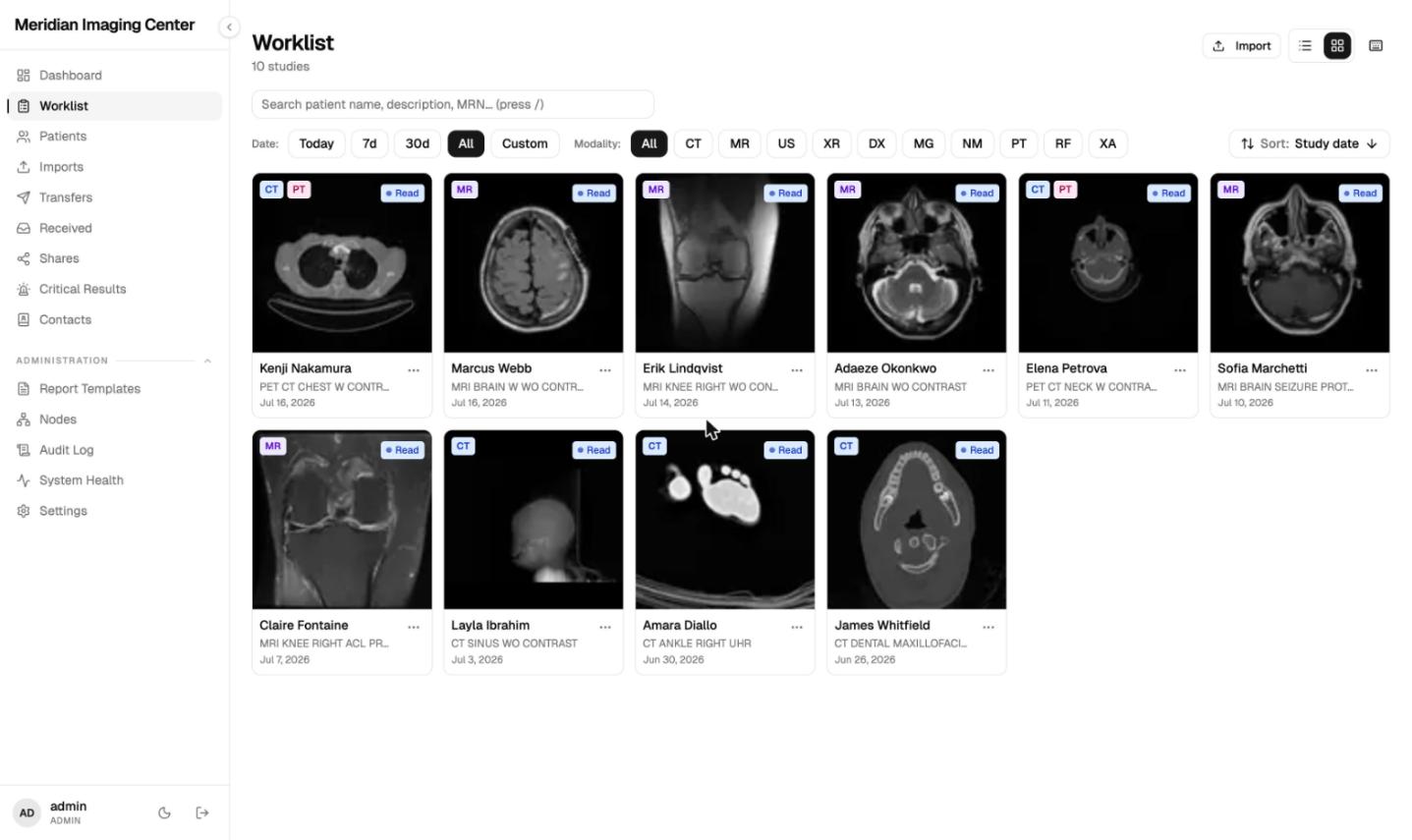
A self-hosted PACS for independent imaging centers. Modalities send studies over DICOM C-STORE, the archive sits on hardware the center controls, and studies open in the browser through three viewers, Stone, OHIF and VolView, from a live worklist. Reports are stored as encapsulated PDFs next to the images, so the archive holds the whole record. It installs with Docker on Linux and runs on a small machine for a single site; the production archive behind it holds millions of images. $300 per location per month, flat. Canonical page: minipacs.net/minipacs/.
Vendo
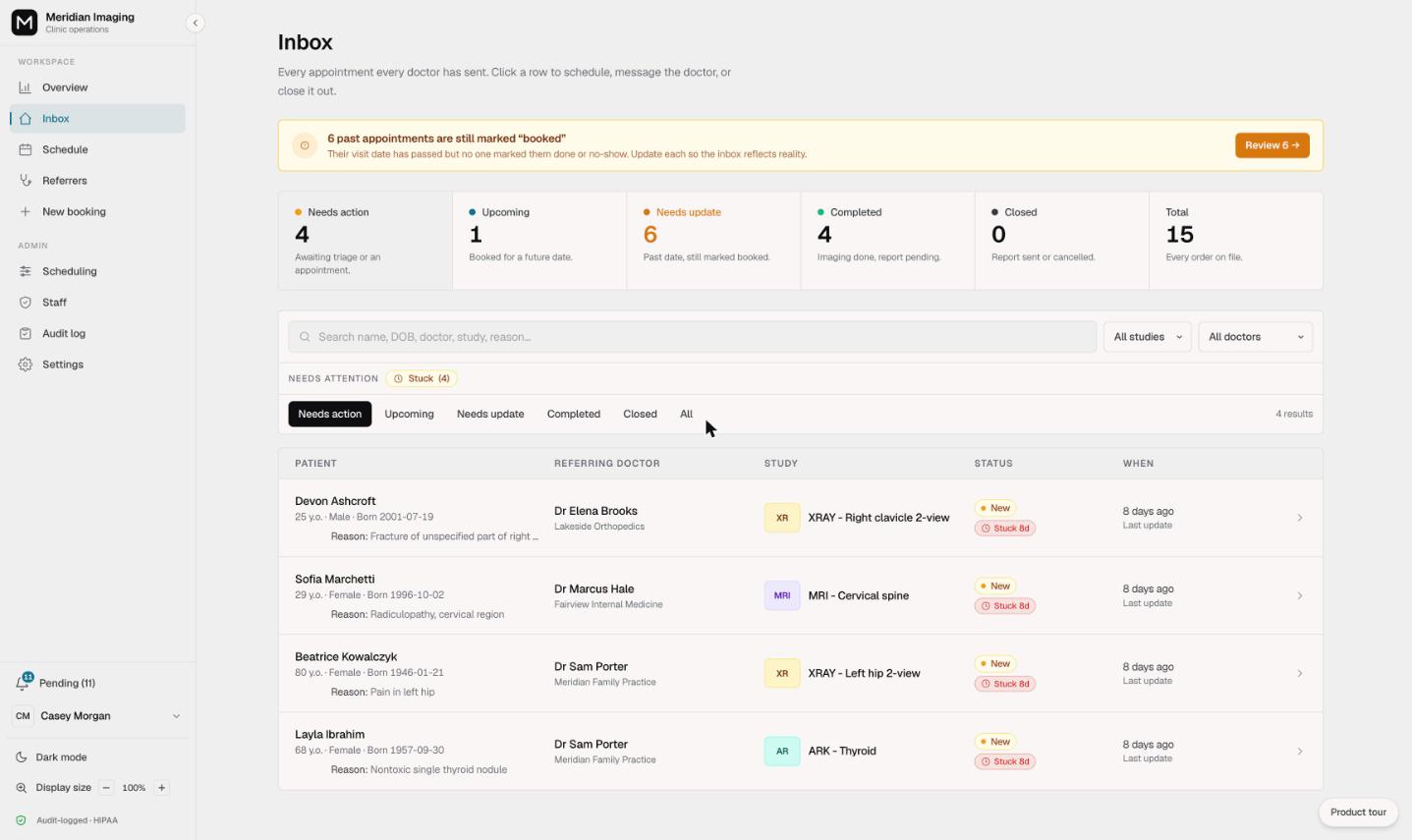
A FHIR-native referral portal built on Medplum, the open-source healthcare platform. It replaces the fax machine on the referral side of an imaging business: referring physicians send orders online, book real appointment slots, and watch their patients move from referred to scheduled to read. $500 per location per month on its own, or $640 together with MiniPACS. Canonical page: minipacs.net/vendo/.
The one-person question, answered
Buying medical software from one engineer raises a fair set of questions. These are the answers as they stand in the license and on the rest of this site.
What if the vendor disappears?
The answer is checkable, not a promise. MiniPACS is self-hosted on hardware you control, and the archive is plain DICOM on an Orthanc core with PostgreSQL indexing. Export is free and complete, standard DICOM plus a database dump, off your own disk. A competent IT partner can operate or migrate it without us.
Who answers when something breaks?
One dedicated person, by phone and email. Response times in hours rather than days are written into the license; a deal that needs specific response times sets them in the contract. Updates and security patches are installed for you.
What happens if we stop paying?
Read-only, never a lockout. Viewing, export and sharing keep working; new studies wait for renewal. This is a commitment in the license, not a switch in the software.
Do you promise uptime?
No. We commit on support, never on uptime. The archive runs on hardware you control, so uptime is yours to hold, which is the point of self-hosting.
Is it HIPAA compliant or FDA cleared?
No software is HIPAA compliant on its own; covered entities pass HIPAA, not products. MiniPACS supports the Security Rule technical safeguards and keeps the data on hardware you control; the control-by-control line is on the security and HIPAA page. No FDA or CE clearance is claimed, and MiniPACS is not a diagnostic-cleared workstation.
What if we need a feature you do not have?
Ask for it. Requests go straight to the person who writes the code, not into a product committee or a change-order pipeline. What fits both products ships in the normal update stream every customer gets; what is truly bespoke gets an honest yes, no, or price before any commitment. The distance between asked and shipped is one conversation, and a no is said out loud rather than parked in a backlog.
Is there a partner channel?
Yes. IT shops that already run Orthanc or OHIF for clinics start as referral partners and can move to reseller; they hold the client and the first call, we carry the product and the second line. Terms are public on the partners page.
Boilerplate
If you are writing about MiniPACS, these are the official descriptions. Copy them as written; they are kept accurate and this page is their canonical home.
MiniPACS is a self-hosted PACS for independent imaging centers in the United States. The DICOM archive, browser viewers (Stone, OHIF and VolView) and worklist install together with Docker on Linux and run on hardware or a cloud account the center controls, so the imaging data stays under the center's control. Modalities send studies over DICOM C-STORE; reports are stored as encapsulated PDFs alongside the images; the production archive holds millions of images. Pricing is flat: $300 per location per month for MiniPACS, $500 for Vendo on its own, or $640 for both. Vendo is a FHIR-native referral portal built on Medplum that puts referring-physician orders and booking online. Both are built and supported by Tim Hunt, an independent engineer. Live demos run at minipacs.net.
How to write the names. MiniPACS is one word: capital M, then PACS in capitals. Search engines and directories sometimes list it as Mini PACS; in text it is always MiniPACS, never MiniPacs or Minipacs. It is unrelated to MiPACS, a dental imaging product from a different company, and to the 2002 academic MiniPACS prototype on SourceForge. The portal is Vendo; the clearest first mention is "Vendo, the MiniPACS referral portal".
Logo
The mark is three stacked layers, a DICOM slice stack, next to the wordmark MiniPACS. The brand is monochrome: use the light version on light backgrounds and the dark version on dark ones, and do not recolor either. What you see below is exactly the file you download.


Need another size or a print format? Ask at tim@minipacs.net and you will get one.
Official profiles
The listings we maintain and declare in this site's structured data, plus the builder's own profiles. Treat any other page that speaks for MiniPACS as unverified until it appears here.